
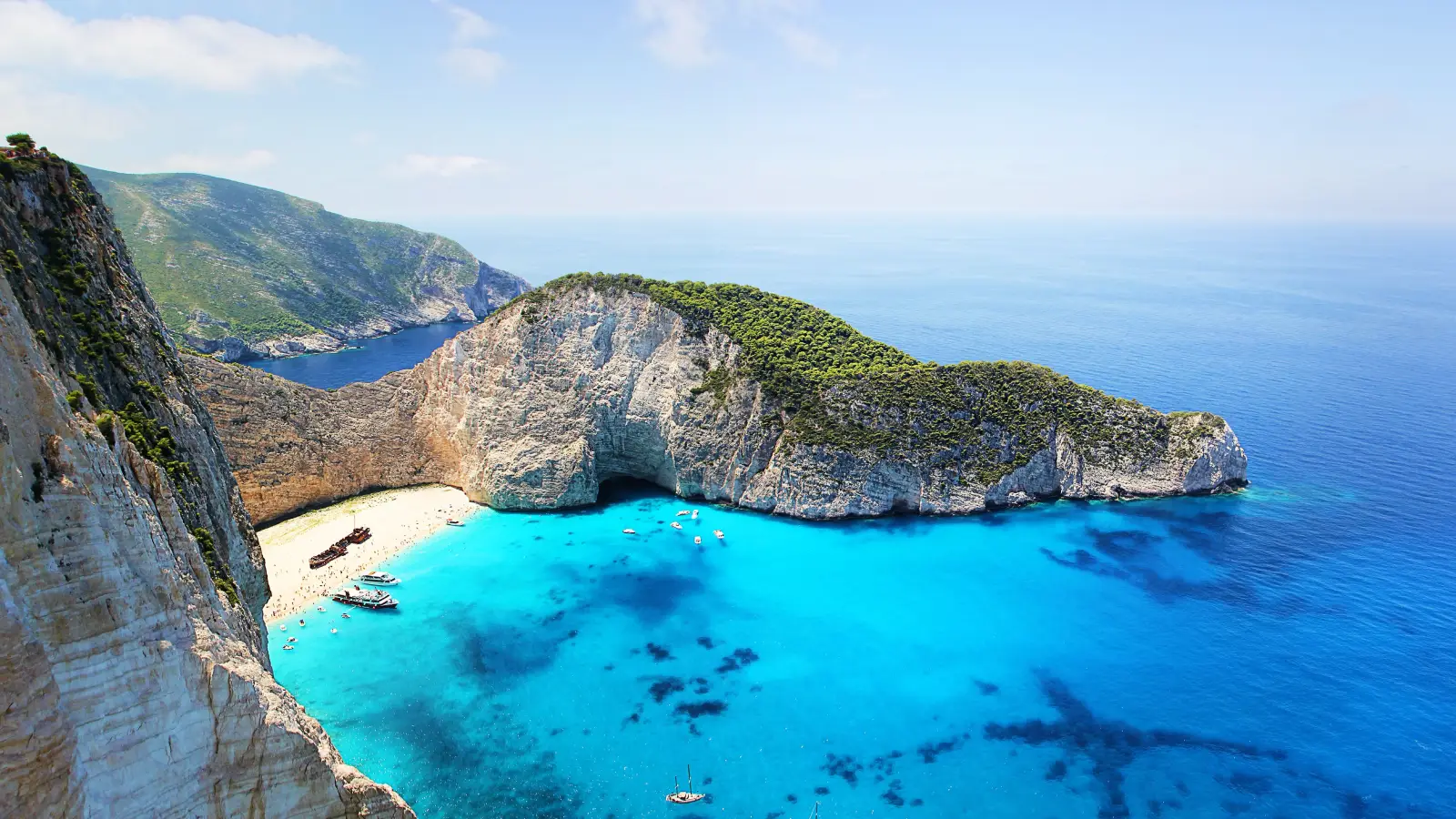

There is a version of your life that runs on Aegean time. Coffee above the Saronic Gulf, your children in an Athens international school, an EU residence card in the drawer. The Cycladic light falls as it has for three thousand years, at a fraction of what the same life costs in the South of France.
The Greece Golden Visa grants you and your family EU residency, visa-free Schengen travel, and the right to live in Greece with no minimum stay, through a single real estate investment. Underneath it sits a tax regime almost nobody explains: a flat €100,000 a year that can shelter your entire worldwide income for fifteen years.
Greece is no longer the cheapest Golden Visa in Europe, and this guide will not pretend otherwise. It is one of the few that pairs a genuine lifestyle with a serious tax instrument. Below: the real numbers, the 2026 rule changes, the tax angle, the honest trade-offs, and a ninety-second test to see whether you qualify.

What the Greece Golden Visa Actually Is
The Greece Golden Visa is a residence-by-investment programme launched in 2013. Non-EU nationals and their families obtain a Greek residence permit by making a qualifying investment, most commonly in real estate. The permit is renewable every five years, and it grants full Schengen mobility.
In 2024, Greece restructured the price. Law 5100/2024 replaced the old flat €250,000 minimum with a tiered system based on location.
| Greece Golden Visa | |
|---|---|
| Standard investment | €400,000 in most of the country |
| Prime-zone investment | €800,000 in Athens, Thessaloniki, Mykonos, Santorini, and islands over 3,100 residents |
| Reduced investment | €250,000 for commercial-to-residential conversions and listed-building restorations only |
| Property rule | Single property, minimum 120 m² |
| Permit validity | 5 years, renewable |
| Minimum stay | None |
| Family included | Spouse, children under 21, and parents of both spouses |
| Citizenship | Eligible after 7 years of real residence |
Note the reduced tier carefully.
The €250,000 figure still circulates all over the internet, but since 2024 it applies only to a narrow category: converting commercial property to residential use, or restoring listed buildings. Greek law firms are blunt that most properties marketed as “€250,000-eligible” do not meet the technical criteria.
This is exactly where working with the right partner matters. At TaxMove, we work directly with developers and projects that genuinely meet the requirements for the €250,000 tier, so instead of chasing listings that fall apart under scrutiny, you get access to properties that actually qualify. For everyone else going the standard route, the real entry point is €400,000.
Thinking about Greece? Let's confirm it's the right move.
Greece can be a lifestyle move, a tax move, or both, and getting it wrong is costly. In your free consultation, we tell you whether the €250,000 is worth it for you, or point you to what is.
The 2026 Rules You Need to Know
Three things changed the calculus recently, and each one matters.
The thresholds went up. The dual-zone system now means Athens, Thessaloniki and the marquee islands require €800,000, while everywhere else requires €400,000. The property must be a single unit of at least 120 m².
Short-term rental is banned. Property acquired for the Golden Visa cannot be let on a short-term basis in the sharing economy, meaning Airbnb-style lets under 60 days. Breaching this triggers a fine of up to €50,000 and revocation of the permit. Long-term letting of 60 days or more remains permitted, with Athens gross yields generally in the 4 to 5% range, so the asset can still produce income, just not holiday-let income.
Greece is now the last one standing. Spain closed its Golden Visa in April 2025. Portugal removed real estate as a qualifying route back in 2023. That leaves Greece as the last major EU programme offering residency through direct property investment, which is precisely why its thresholds rose: demand concentrated on the one door still open.
The permit itself remains strong. Visa-free Schengen travel, no obligation to live in Greece, family included, and eligibility for citizenship after seven years of genuine residence, subject to a Greek language requirement.
Key Points
- The real entry point for a standard purchase is €400,000, or €800,000 in prime zones
- The €250,000 tier survives only for conversions and listed-building restorations
- The property must be a single unit of at least 120 m²
- The permit runs 5 years, renewable, with no minimum stay
- Short-term (Airbnb-style) rental is banned; long-term letting is allowed
- Greece is the last major EU Golden Visa offering residency through direct property purchase
- Citizenship is possible after 7 years of real residence, with a Greek language test
- The Golden Visa pairs directly with the €100,000 non-dom tax regime
Taxes in Greece: The Part Nobody Explains Properly
Greece has a progressive income tax that climbs to 44% at the top. On its own, an ordinary European number, and if that were the whole story, Greece would be a lifestyle choice rather than a tax one.
It is not the whole story. Greece operates a non-dom lump-sum regime for high-net-worth individuals who move their tax residency to the country. You pay a flat €100,000 per year, and that single payment covers all your foreign income, no matter how large, for up to fifteen years: dividends, capital gains, interest, foreign business profits, all of it. Family members can be added for €20,000 each, and foreign assets fall outside Greek inheritance and gift tax.
Here is the connection almost every article misses: the regime requires a €500,000 investment, and a single €500,000 property can serve both the Golden Visa and the non-dom regime at once. You invest once, and it counts twice. Just mind the figure: the Golden Visa starts at €400,000, but the regime needs €500,000, so size the property for the higher number if the tax break is the goal.

Do You Qualify? A Ninety-Second Test
Answer these five honestly.
1. Are you a citizen of a non-EU, non-EEA country? If not, you already have the right to live in Greece and do not need this programme.
2. Can you invest at least €400,000 in a qualifying property, or access a genuine €250,000 project? The €250,000 tier exists only for conversions and restorations, and qualifying stock is scarce. At TaxMove we work with developers and projects that do meet those criteria, but for a standard purchase, budget for €400,000 as the realistic floor, or €800,000 in a prime zone.
3. Is your goal EU residency and optionality, with a tax upside if you relocate? The visa alone gives you residency and Schengen access. The tax benefit only activates if you make Greece your tax home and elect the non-dom regime.
4. If you want the €100,000 tax regime, have you avoided Greek tax residency for seven of the last eight years? This is the hard eligibility gate for the tax side. The visa does not require it. The non-dom regime does.
5. Are you comfortable that the property cannot be short-term rented? Long-term letting is fine, but the Airbnb-style model is off the table under the 2024 rules.
Five yeses makes you a strong candidate for the full residency-plus-tax strategy. A no on question 4 still leaves you a perfectly good residency play, just without the headline tax break.
The Greek Passport: A Real-Residence Road, Not a Shortcut
The Greece Golden Visa is a residence programme, and it is worth being clear about what it does and does not lead to.
After seven years, holders can become eligible to apply for Greek citizenship. But unlike the permit, which asks nothing of your physical presence, citizenship requires genuine residence across those years, plus a Greek language exam and an integration interview. Greek is a hard language to reach exam standard in, and naturalisation is slow and document-heavy.
So the same tension runs through Greece as through most of Europe. The permit’s zero-stay flexibility is the exact opposite of what naturalisation demands. You cannot hold the visa at arm’s length for seven years and expect a passport. You either treat Greece as an asset held without living there, or you actually move and pursue the passport on real presence.
Both are legitimate. They are simply not the same plan, and the €100,000 tax regime is built for the first, not the second.
The Honest Trade-offs
Every programme has them. Here are Greece’s, stated plainly.
It is no longer cheap, unless you find a genuine €250,000 project. The €400,000 and €800,000 tiers put Greece well above Hungary’s €250,000, and the capital is committed before you apply, not after. That is exactly where working with the right developers makes the difference
The €100,000 regime is not for everyone. It only makes sense above roughly €300,000 of annual foreign income. Below that, you would pay more in flat tax than under normal rates, and the regime works against you.
Citizenship is a real-residence road. Seven years, but genuine residence, plus a Greek language requirement. This is not a passport you collect while living elsewhere.
The rental restriction is real. Short-term letting is banned. The property can produce long-term rental income, but the high-yield holiday-let model no longer applies.
None of this disqualifies Greece. It simply means Greece rewards a specific profile: someone with significant foreign income who wants a Mediterranean base and is prepared to make it their tax home. For that person, few programmes in Europe compete.
Greece vs Hungary vs Portugal: The 2026 Picture
| Greece | Hungary | Portugal | |
|---|---|---|---|
| Real entry point | €400,000 (€800,000 prime; €250,000 conversions) | €250,000 | €250,000 donation or €500,000 fund |
| What you hold | A property, 120 m² minimum | Recoverable fund units | Donation, or fund units |
| Permit validity | 5 years, renewable | 10 years, renewable to 20 | Renewed every 2 years |
| Minimum stay | None | None | 7 days per year on average |
| Headline tax draw | €100,000 non-dom flat tax | 15% flat, 9% corporate | Progressive to 48%, unless IFICI applies |
| Citizenship | 7 years, real residence, Greek test | 8 years, Hungarian test | 10 years, A2 Portuguese |
Read the tax row across.
Hungary wins on low headline rates and a cheap, recoverable entry. Greece wins for one specific person: the high-income individual who will relocate and wants a single fixed number to cap a large, complex, globally-sourced income.
How TaxMove Can Help You
Most firms do one piece. A property agent sells the apartment, a lawyer files the permit, a tax adviser handles the non-dom election. Nobody owns the whole outcome, and the gaps between them are exactly where a Greek move goes wrong.
We handle the entire arc, in the right order:
- Structure first. Before you buy anything, we check whether the €100,000 regime actually fits your numbers, the step that decides whether Greece saves you money or just costs you €400,000.
- The qualifying investment. We guide the purchase so it meets the Golden Visa criteria cleanly and doubles as the €500,000 anchor for the non-dom regime where that is the goal.
- Residency and the tax election. We manage the permit and, where it fits, the non-dom filing that caps your foreign income at a flat €100,000 a year.
- The long game. If your aim is the passport, we map the real-residence path to citizenship from day one, so nothing in year one disqualifies you in year seven.
One team, one plan, from the first question to the final card. Whether Greece is your move or Hungary or Portugal fits better, the answer comes from your full position, and that is where we start.
Book your free initial consultation and we will build it with you, before you commit a single euro. Your Move Starts Here.
Frequently Asked Questions About the Greece Golden Visa
How much is the Greece Golden Visa in 2026?
€400,000 for a standard property, or €800,000 in Athens, Thessaloniki and prime islands. A €250,000 tier survives only for commercial conversions and listed-building restorations.
Is the Greece Golden Visa still €250,000?
Only for a narrow category of conversion and restoration projects. For a standard purchase, the real minimum is €400,000 since Law 5100/2024.
Do I have to live in Greece to keep the Greece Golden Visa?
No. The permit has no minimum stay requirement. Residence is only required if you later pursue citizenship or elect the non-dom tax regime.
Does a €400,000 Golden Visa qualify me for the non-dom tax regime?
Not on its own. The Golden Visa starts at €400,000, but the non-dom regime requires €500,000. Buy a single property at €500,000 or more and it covers both at once.
Can the Greece Golden Visa lead to citizenship?
Yes, after seven years of genuine residence, plus a Greek language requirement. It is not a fast passport route.
Can I include my family in the Greece Golden Visa?
Yes. Spouse, children under 21, and the parents of both spouses can be included in a single application.
Can I rent out my Greece Golden Visa property?
Long-term letting of 60 days or more is allowed. Short-term, Airbnb-style rental is banned, with fines up to €50,000 and permit revocation.
Who is eligible for the Greece Golden Visa?
Non-EU and non-EEA citizens who can make a qualifying property investment and document a lawful source of funds.