

Did you know there’s a country in the heart of Europe that feels culturally Western, is geographically connected to the Mediterranean, affordable, safe and openly non-woke, where entrepreneurs can legally operate at an effective tax rate close to 10%?
It offers a European lifestyle without the ideological overreach, tax aggression and regulatory chaos that now define much of the EU. A place where you can run a global business, enjoy world-class infrastructure and still keep more of what you earn.
That country exists. And it’s not Andorra, Cyprus or Malta. It’s Serbia, the new low-tax base for serious digital entrepreneurs.
For more than a decade, European entrepreneurs searching for low-tax residency options repeated the same four names endlessly: Andorra, Cyprus, Malta and Estonia.
These jurisdictions shaped the early landscape for location-independent professionals, promising reduced tax burdens, access to European markets and a regulatory framework that felt more flexible than in the large Member States.
But the environment has changed. EU tax harmonisation, aggressive banking compliance, expanded CRS and DAC reporting, and increasingly interventionist tax authorities have fundamentally altered the practicality of those systems, especially for modern online entrepreneurs running highly mobile, low-overhead businesses.
Into this vacuum steps a jurisdiction that barely featured in the previous decade: Serbia, where effective taxation can remain below 10 percent.
Not because of marketing. Not because of digital nomad visas. And not because of artificial exemptions. Serbia is rising because its tax structure, financial system and lifestyle conditions align almost perfectly with how modern digital professionals earn, spend and operate.
This article offers an in-depth, narrative-driven analysis of why Serbia is becoming one of the most strategically sound low-tax bases in Europe, particularly for solo entrepreneurs, freelancers and online consultants, and how Serbia taxes actually work in practice.
Serbia Taxes: A Simple, Predictable Low-Tax System
Serbia’s tax system stands out in Europe for its simplicity, stability and internal consistency. Instead of layered regimes, refund mechanisms or constantly shifting interpretations, Serbia applies clear flat rates and economically coherent rules. For entrepreneurs, this creates a rare environment where tax planning is straightforward, compliance is predictable and long-term decisions can be made without regulatory surprises.
Corporate Taxation in Serbia
Serbia’s corporate tax system stands out for its clarity and internal coherence. Companies are subject to a flat 15% Corporate Income Tax, applied without the complex imputation systems, refund chains or artificial substance requirements found in jurisdictions such as Malta.
Business expenses are interpreted pragmatically and in line with economic reality. Software tools, online subscriptions, advertising, contractor fees, equipment, professional training and cross-border operational costs are generally recognised as legitimate and fully deductible.
For companies operating in technology, innovation or knowledge-based industries, the framework becomes even more attractive. Income derived from intellectual property developed in Serbia may benefit from up to an 80% exemption, while research and development expenses can be deducted at 200% of their value. These incentives are designed for businesses that genuinely create value, not for artificial structures.
What ultimately distinguishes Serbia taxes is not just its nominal tax rate, but the predictability of its application. The rules are clear, stable and economically logical, qualities that have become increasingly rare across Europe.
Personal Income Tax in Serbia
Serbia’s personal income tax system is intentionally simple and particularly attractive for digital entrepreneurs. Income is taxed by category at flat rates of 10%, 15% or 20%, creating a framework that is easy to understand and even easier to plan.
Employment income, including the salary you pay yourself as a founder, is generally taxed at 10%, one of the lowest mainstream rates in Europe. Dividends and other investment income are typically taxed at 15% for Serbian tax residents, allowing profits to be extracted without the heavy combined tax burden common in most EU jurisdictions.
What truly sets Serbia apart is the stability of its personal tax rules. There is no worldwide taxation for non-residents, no wealth taxes and no aggressive anti-avoidance frameworks designed to recharacterise legitimate income. For professionals who value predictability, low rates and frictionless compliance, Serbia offers one of the most coherent personal tax regimes in Europe.
Social Security Contributions in Serbia
While Serbia offers very low personal income tax rates, its social security contributions are comparatively high. Employees typically contribute close to 20% of gross salary toward pension, health and unemployment systems, while employers add roughly another 15%. The combined burden reaches around 35% of gross salary. Although contributions are capped, the overall cost remains significant.
For this reason, Serbia works exceptionally well for entrepreneurs who structure their income efficiently, combining a modest salary with dividends or business profits. It is far less attractive for individuals relocating purely as employees.
Tax Treatment of Foreign Companies in Serbia
Many entrepreneurs considering Serbia already operate through international structures such as US LLCs, UK Ltds, Hong Kong companies or UAE FZCOs. When assessing Serbia Taxes, these setups can often be maintained without automatic reclassification, provided they are properly structured and genuinely managed abroad.
Serbian tax practice is generally less aggressive than that of many EU jurisdictions when it comes to foreign entities. Ownership of an overseas company by a Serbian tax resident does not, by itself, trigger taxation in Serbia, as long as the place of effective management and any permanent establishment remain clearly outside the country. This is typically supported through foreign directors, documented decision-making processes, and real operational substance abroad.
This relative flexibility allows entrepreneurs, in many cases, to preserve existing international structures while benefiting from a stable and predictable European tax residency. That said, each situation must be analysed on a case-by-case basis, taking into account the specific facts, jurisdictions involved, and the actual conduct of the business, to ensure compliance and avoid unintended tax exposure.
Dividends received by Serbian tax residents are generally taxed at 15%, a rate broadly in line with other business-friendly European jurisdictions.
Exploring Serbia? Let's confirm it's the right move.
Every situation is different. In your free consultation, we’ll assess whether Serbia is your best option for tax residency, or point you toward an alternative that suits you better.
Serbia’s Sole Proprietorship Regime: The Preduzetnik Explained
The true breakthrough for digital entrepreneurs in Serbia lies in its sole proprietorship regime, known as the Preduzetnik. Very few tax models in Europe offer such a transparent, low-bureaucracy path to sustainable and long-term tax efficiency.
Under this structure, the individual operates as a business without forming a company. Revenue and expenses are declared directly, and net profit is taxed at 10%, with mandatory social contributions fully deductible. Crucially, there is no second layer of taxation when profits are withdrawn. The result is a level of simplicity that is increasingly rare in Europe. For many online entrepreneurs, the effective tax burden remains below 10%, without relying on artificial incentives or temporary preferential regimes.
This model is particularly well suited to high-margin digital professions where income is driven by personal expertise rather than organisational scale. Consultants, coaches, designers, software developers, online marketers, content creators and similar professionals benefit the most, as the structure aligns taxation with how value is actually generated.
This is where Serbia clearly outperforms traditional low-tax jurisdictions. Instead of subsidies, exemptions or time-limited programs, the Preduzetnik is built on economic reality, structural simplicity and predictable rules, making it one of the most robust and sustainable tax regimes available to independent entrepreneurs in Europe.
Tax residency in Serbia
Serbia follows internationally recognised tax residency standards. You are considered a tax resident by spending more than 183 days in the country or by establishing your residence or centre of vital and economic interests there. What sets Serbia apart is not the definition itself, but the way it is applied in practice.
In a context where many Western tax authorities increasingly reclassify independent activity as employment or stretch permanent establishment rules to capture digital business models, Serbia takes a notably pragmatic approach. There is no systematic tendency to recharacterise foreign income without solid legal grounds, nor to treat online entrepreneurs as suspicious by default.
For remote professionals accustomed to navigating shifting interpretations and expanding enforcement, Serbia offers something that has become increasingly rare: certainty. You can plan your year, structure your business and file your taxes with confidence that the rules will be applied as written, not retroactively reinterpreted.

Visa Types and Residence Permit
For nationals of visa-free countries, such as the European Union, the United States, or the United Kingdom, there is no need to apply for a special visa to enter Serbia. You can enter the country and start the residency process from within.
However, visa-free entry does not allow long-term stays. If you plan to remain in Serbia, you will need to apply for a residence permit.
In most cases, this involves obtaining a temporary residence permit based on employment, running a business, or other economic grounds.
For non visa-free nationalities, the process typically begins with a D-type visa, followed by the residence permit application once in Serbia.
Serbia’s Unique Position: European in Daily Life, Independent from EU Law
Serbia occupies a rare and strategically powerful position. It sits outside the European Union, yet remains deeply integrated into European economic life. Cities such as Belgrade and Novi Sad feel immediately familiar to anyone accustomed to Western or Central Europe, offering modern cafés, reliable public transport, a vibrant cultural scene, excellent internet infrastructure and a cost of living well below EU averages.
The country’s recent integration into SEPA represents a major shift. Euro transfers, client payments, business transactions and daily banking now operate with the same efficiency as within the EU. For entrepreneurs working with European clients, this delivers European-standard financial operations without exposure to EU tax harmonisation.
This dual structure is precisely what many digital entrepreneurs have been seeking. You live in Europe, operate in Europe and serve European markets, while remaining outside the reach of ATAD rules, expanded DAC reporting and the growing substance requirements imposed on companies within EU Member States.
Serbia fills a gap that had remained open for years. It offers a genuinely European environment combined with simple taxation, predictable regulation and legal independence, a combination that has become increasingly rare on the continent.
Banking in Serbia
Opening a bank account in Serbia can be slow, bureaucratic and surprisingly rigid, particularly for foreign entrepreneurs. Compliance checks are extensive, documentation requirements are demanding and onboarding often takes several weeks. Serbia is an excellent low-tax base, but its domestic banking system is not designed for fast-moving digital businesses that require reliable international banking from day one.
With our Premium Banking Service, these limitations can be bypassed entirely. We help you open accounts in top-tier jurisdictions such as the United States, Luxembourg, Switzerland or Singapore, giving you access to strong multi-currency infrastructure and private-banking level stability. The reality is simple: a solid tax residency without robust banking is incomplete. We make sure you have both.
Serbian Passport and Citizenship
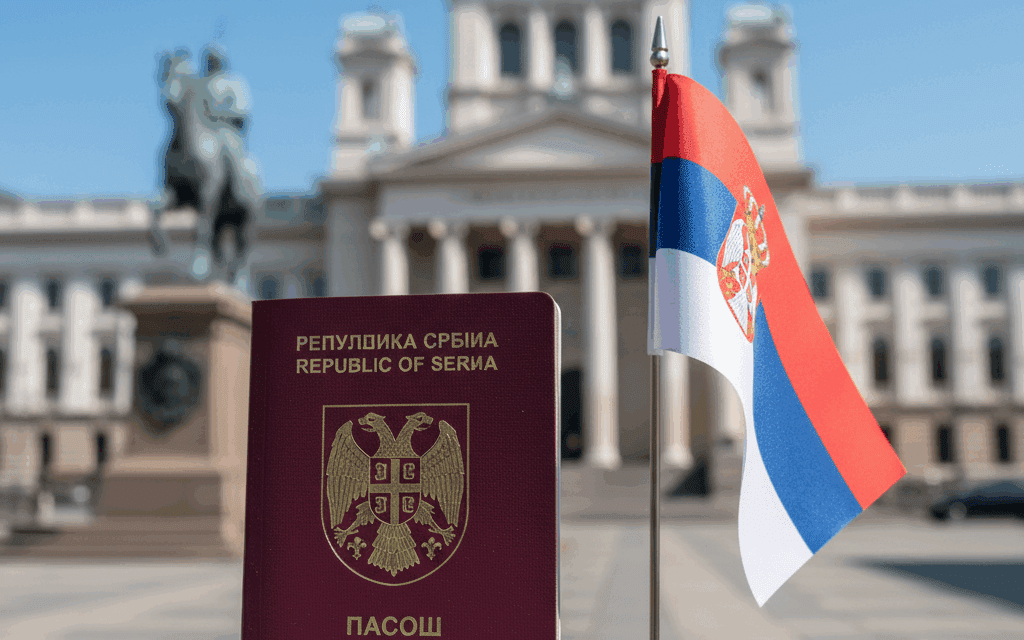
Serbia offers a relatively straightforward path to temporary and permanent residency, but obtaining a Serbian passport is a very different matter. While naturalisation is possible after several years of legal residence, it typically requires renouncing your existing citizenship, as Serbia does not broadly recognise dual nationality outside limited exceptions.
For this reason alone, the Serbian passport is rarely an attractive objective for international entrepreneurs. Serbia excels as a tax residency and operational base, but for those seeking a second citizenship, far stronger and more flexible options exist elsewhere.
Other Benefits and Anti-Avoidance Rules
Serbia complements its low-tax framework with a set of anti-avoidance rules that are clear, proportionate and aligned with international standards. Rather than expanding their scope through aggressive interpretation, Serbian authorities focus on legal certainty and objective criteria.
Double Tax Treaties
Serbia maintains an extensive network of more than 60 double tax treaties, providing international entrepreneurs with legal clarity and protection when operating across borders. These agreements help prevent double taxation, reduce withholding taxes and create a stable framework for cross-border business activity.
In particular, they allow investors to reduce the standard 20% withholding tax on dividend distributions from Serbian companies. Depending on the applicable treaty, this rate can often be lowered significantly, improving the overall efficiency of profit distribution.
Controlled Foreign Company (CFC) Rules
Serbia does apply controlled foreign company rules, but they are enforced in a clear, proportionate and predictable manner. The focus remains on genuinely abusive arrangements rather than on legitimate international business structures.
Unlike the increasingly expansive interpretations seen in many EU Member States, Serbian CFC rules are not used as a tool for arbitrary reclassification. This allows entrepreneurs to operate globally without constant uncertainty over how foreign income will be treated.
Exit Tax
Serbia does not impose an exit tax on individuals who change their tax residency. This contrasts sharply with several EU jurisdictions that tax unrealised capital gains upon departure.
For mobile entrepreneurs, this absence of exit taxation provides genuine freedom of movement. You can restructure your life or relocate internationally without facing punitive fiscal consequences simply for leaving the country.
Serbia as a Low-Tax Base: A Definitive Review
Serbia Compared to Andorra, Cyprus and Malta
For many years, Andorra, Cyprus and Malta dominated the discussion around low-tax living in Europe. While they remain functional, they no longer offer the straightforward, low-friction solutions they once did.
Andorra still works well for high-net-worth individuals and established corporate groups. For freelancers or lean agencies, however, it often adds unnecessary friction, including mandatory incorporation, higher living costs and limited scalability.
Cyprus, with a 15% Corporate Income Tax rate, is now firmly embedded in the EU’s tax trajectory. Banking requirements have tightened, substance expectations have increased and audits are noticeably stricter than in the past.
Malta continues to allow low effective taxation, but only through complex refund mechanisms and substance-heavy structures that face growing scrutiny from EU institutions.
Serbia stands outside this dynamic. It offers efficient taxation without imputation systems, without complex or artificial corporate structures, and without EU oversight. For internationally operating, knowledge-based entrepreneurs, Serbia is not merely competitive. It is structurally better aligned with the realities of digital business.
Who Serbia Is Actually Ideal For
The typical entrepreneur choosing Serbia is not a multinational executive or a large corporate investor. It is a highly skilled professional monetising personal expertise globally. Consultants, coaches, developers, designers, content creators and online educators benefit the most from Serbia’s environment.
These profiles value clarity, predictability and cost efficiency, and Serbia delivers on all three. The combination of low effective taxation, SEPA integration, a European lifestyle and minimal bureaucratic friction creates an ecosystem few jurisdictions can currently match.
For those planning long-term, Serbia offers something increasingly rare in Europe: a tax and regulatory system built on stable structural rules, rather than temporary incentives exposed to political and regulatory shifts.
How Can We Help You?
Serbia’s rules may look simple on paper, but without the right guidance, even the best low-tax jurisdiction can turn into a maze of paperwork, delays and unexpected penalties. At TaxMove, we ensure your entire transition is handled correctly, from tax residency and compliance to banking, business setup and every detail required to make your move legally solid and strategically optimised.
If you are ready to take the next step to lower your taxes, simplify your structure and operate from a country that genuinely works for digital entrepreneurs, book your Free Initial Consultation today. Let’s make Serbia your efficient and sustainable tax base, built to last.
Is Serbia part of the European Union?
No. Serbia is not an EU member, which lets it maintain low taxes and flexible regulations while still offering European lifestyle standards and SEPA banking integration.
Is Serbia a tax haven?
No. Serbia is a normal, treaty-based jurisdiction with transparent rules. It’s simply a low-tax, business-friendly environment, not a traditional tax haven.
What is the taxation in Serbia?
Serbia offers a simple and efficient tax framework: low rates, clear rules and predictable enforcement. Digital entrepreneurs often operate with a total effective tax burden far below what they would face in EU Member States.
What are the taxes in Serbia?
Corporate Income Tax is 15% with generous deductions and strong incentives for IP and R&D. Personal income is taxed at 10%, 15% or 20%, depending on the category — salaries at 10%, dividends at 15%, and specific income types at 20%.
How does the sole proprietorship (preduzetnik) tax regime work?
You operate as an individual business and pay 10% on net profit, deduct mandatory contributions and avoid double taxation. For many online professionals, the effective rate remains below 10%.
What are the tax residency rules in Serbia?
You become tax resident by spending more than 183 days in the country or by establishing your residence or center of business and economic interests there.
Do I need a visa to live in Serbia?
Nationals of visa-free countries can enter Serbia without a visa and apply for a residence permit from within the country. Non visa-free nationals typically need a D-type visa before arrival. In all cases, staying long term requires a residence permit based on work or other economic grounds.
Who is Serbia ideal for?
Serbia is ideal for solo entrepreneurs, consultants, developers, freelancers, agency owners and digital professionals who want European living with ultra-low, predictable taxation.
How can I obtain a Serbian passport?
You can apply for citizenship after several years of legal residence, but the process is selective and typically requires renouncing your current citizenship.
How is banking in Serbia?
Banking in Serbia is safe but highly bureaucratic, and opening an account as a foreigner can take several weeks due to strict compliance checks. While the system works, most entrepreneurs prefer using international accounts in the US, Luxembourg, Switzerland or Singapore for smoother onboarding and stronger global banking infrastructure.